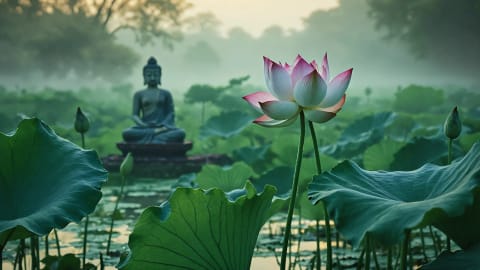
It may be the oldest and simplest spiritual question: who am I? Children ask it. Philosophers have written libraries about it. Vedanta says the honest pursuit of this one question can lead to freedom.
The question in many voices
On Platonix, several teachers approach the question from different angles.
In Self Realisation | Who Am I?, Vanamali Mataji draws on the Bhagavad Gita, asking: am I only this body, this mind, these thoughts, or is there something deeper that never changes? The Gita's answer is that our true identity is the eternal Self (ātman), beyond birth and death. Her short satsang clip What is this I returns to the same question, which, as its description says, lies at the heart of all spiritual inquiry.
The Jiva Balance Pause for Wisdom series devotes two talks to Ātma-Chintanam, reflection on the Self (Days 28 and 29). And in modern times the question is closely associated with the sage Ramana Maharshi, whose short text Who Am I? (Nān Yār?) has introduced countless people to self-inquiry.
"I am, therefore I can think"
Day 29 of the Jiva Balance series offers a memorable contrast. Western philosophy famously said, "I think, therefore I am." Vedanta, the talk suggests, reverses the order: I am, therefore I can think.
Existence comes first. Thoughts arise in it. Before any thought about who you are, you already are. That simple, undeniable being is the starting point of self-inquiry.
Why the human mind is a gift
Day 28 frames self-inquiry as the highest use of the human intellect. We have a mind and intellect capable of discerning right from wrong, permanent from impermanent, appearance from truth. If we use this only for possessions, status and endless becoming, the talk suggests, we reduce a sacred instrument to a tool of survival and ambition. Vedanta reminds us that its true purpose is the discovery of our real nature.
How self-inquiry works
Self-inquiry is not about finding a clever verbal answer. Any answer, "I am a soul", "I am consciousness", is still a thought. The practice is to turn attention towards the one who knows thoughts.
Vedanta typically proceeds in two movements:
1. Negation: "not this, not this"
- I can observe my body, so I am not merely the body.
- I can observe my feelings, which change constantly, so I am not merely my feelings.
- I can observe my thoughts, so I am not merely my thoughts.
- I can even observe the sense of being a particular person with a history, so I am not merely that story.
What remains when all that can be observed is set aside?
2. Recognition: what remains
What remains is not a blank. It is the awareness that has been present all along, knowing each of these. Vedanta calls it the Self, ātman, and teaches that it is not limited by the body or mind.
A simple practice (10 minutes)
- Sit quietly and close your eyes. Let the body settle.
- Notice the sense of "I". Feel the simple sense of being here.
- Ask gently: "Who am I?" Do not answer in words. Notice where attention goes.
- When a thought comes, notice it and ask, "To whom does this thought arise?" The answer is "to me". Then return to the question: "Who am I?"
- Rest in whatever quiet or spaciousness appears, without trying to hold on to it.
Some days this will feel natural, others merely mental. Both are fine. Regular, relaxed practice matters more than dramatic experiences.
Common misunderstandings
- "I have to stop thinking." No. Thoughts can continue; the point is to see that you are not limited to them.
- "This is self-absorption." Self-inquiry is not obsessing about personal problems. It is inquiry into the nature of awareness, which tends to make people less self-centred, not more.
- "I'll reach a special state." Experiences come and go. What is sought is a clear understanding of what is always present.
- "I can skip ethics and devotion." Vedanta consistently stresses a prepared mind: honesty, kindness, humility and discipline make inquiry clearer.
The Gita's perspective
The Bhagavad Gita (2.20) describes the Self as never born and never dying, not slain when the body is slain. Chapter 13 distinguishes the field, body and mind, from the knower of the field. Read in this light, the Gita is an extended answer to "Who am I?" given to a person in crisis. Vanamali Mataji's talk emphasises exactly this practical side: understanding our true identity helps us overcome fear, attachment and confusion.
Self-inquiry with care
Self-inquiry is generally gentle, but if you are going through a period of mental health difficulty, especially feelings of unreality or detachment, it is wiser to focus on grounding practices and seek support from a qualified professional before intensive inquiry.
Listen and reflect
Watch Vanamali Mataji's Self Realisation | Who Am I? on Platonix, then the Jiva Balance talks Ātma-Chintanam – The Path of Self-Inquiry and Existence Before Thought. Each offers a different doorway into the same question.