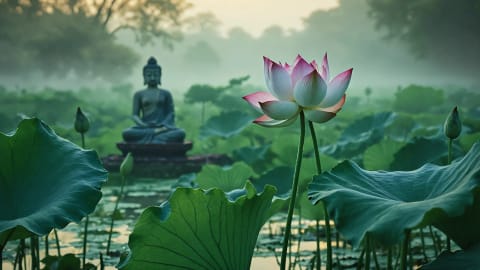
Most articles about sleep are about getting more of it. This one is about something else: what sleep, especially deep, dreamless sleep, can teach us about who we are. Vedanta has paid close attention to this nightly experience for many centuries, and its observations are both simple and startling.
Three states, every day
Vedanta notes that every human being moves through three states of experience:
- Jāgrat: the waking state, with the body, senses and the external world.
- Svapna: the dream state, where the mind creates its own world.
- Suṣupti: deep, dreamless sleep, where neither world appears.
We take these for granted, yet they raise a question. Which state shows us what we really are? In waking we identify with the body; in dreams with a dream body; in deep sleep with nothing at all. And yet we are present in all three.
The three bodies
Alongside the three states, Vedanta describes three bodies (śarīra traya):
- Sthūla śarīra, the gross body, made of the five elements.
- Sūkṣma śarīra, the subtle body: organs of perception and action, the vital energies, mind and intellect.
- Kāraṇa śarīra, the causal body, made of latent tendencies.
The Pause for Wisdom series on the Jiva Balance channel on Platonix walks through these over several days. In the Day 113 talk, The Subtlest: Beyond Gross and Subtle – Causal, the teacher links the causal body directly to deep sleep.
Why the causal body is the subtlest
The talk begins from a principle explained the day before: what is subtler is more pervasive, and the cause is always subtler than the effect. "The effect may be vibrant, may be multicoloured, may be dynamic," the teacher says, "but in and through all this, that cause is pervading."
Then comes the observation from experience. In waking and in dreams there are thoughts of all three qualities, sattva, rajas and tamas. But what about deep sleep? In the talk's words: "Is there a mind? Is there a thought? No thought, no mind, not even space." The causal state is subtler than both the gross and the subtle bodies, because in it even the mind is resolved into its seed form.
"I slept well"
The Day 106 talk on the causal body adds the crucial step. Even in deep sleep, it notes, we later report "I slept well". How could we report it if no one was there? The talk's description draws the conclusion: I, the conscious Self, illumine both the presence and absence of thoughts. Therefore I am not the causal body either; I am beyond it.
This is one of Vedanta's most elegant arguments:
- In deep sleep there are no thoughts, no world, no sense of a body.
- Yet on waking, we remember that we existed and that it was peaceful.
- So awareness was present even when everything else was absent.
- That awareness is not the body, not the mind, and not the blank of sleep. It is what knows all three states.
The peace of deep sleep
Notice what we say about deep sleep: it was restful, peaceful, happy. No one complains of a bad dreamless sleep. Vedanta points out that this peace does not come from any object. In deep sleep we have no possessions, no achievements, no relationships in mind, and yet we are at peace.
This suggests that peace is not something we need to acquire; it is uncovered when the agitation of thoughts subsides. The difference with deep sleep is that it is unconscious. Vedanta's aim is to recognise, while awake, the awareness in which that peace is present.
Beyond all three
After the causal body, the Jiva Balance series continues to Day 114, Beyond the Gross and the Subtle: The Pure Self, describing the Self as untouched, ever-present, self-effulgent consciousness, subtler than the subtlest. The three bodies change; the three states come and go; the awareness that knows them does not.
The Māṇḍūkya Upaniṣad names this the turīya, literally "the fourth": not a fourth state alongside the others, but the awareness present in and through all three.
A reflection before sleep
You can bring this teaching into your evening in a simple way. Lying in bed:
- Notice the body: its weight, warmth, small sensations.
- Notice the mind: thoughts arriving and fading.
- Notice that you are aware of both.
- As sleep approaches, let go of trying to stay aware. Simply rest in the sense that whatever happens, awareness is not going anywhere.
Some people find this a peaceful way to fall asleep; others prefer to keep philosophy for the daytime. Either is fine.
Practical sleep notes
Although this is a philosophical piece, a few practical points are worth adding:
- Regular sleep and wake times support the body's rhythm.
- Screens and heavy meals late in the evening can make it harder to fall asleep.
- A short wind-down practice, such as gentle stretching or yoga nidra, can help.
- Persistent insomnia or very poor sleep deserve medical attention. Please consult a qualified professional.
Listen to the series
Start with Day 113 on the Jiva Balance channel on Platonix, a talk of under six minutes that ends with a short guided alignment of body, mind and intellect, then continue with the talk on the causal body and The Pure Self.